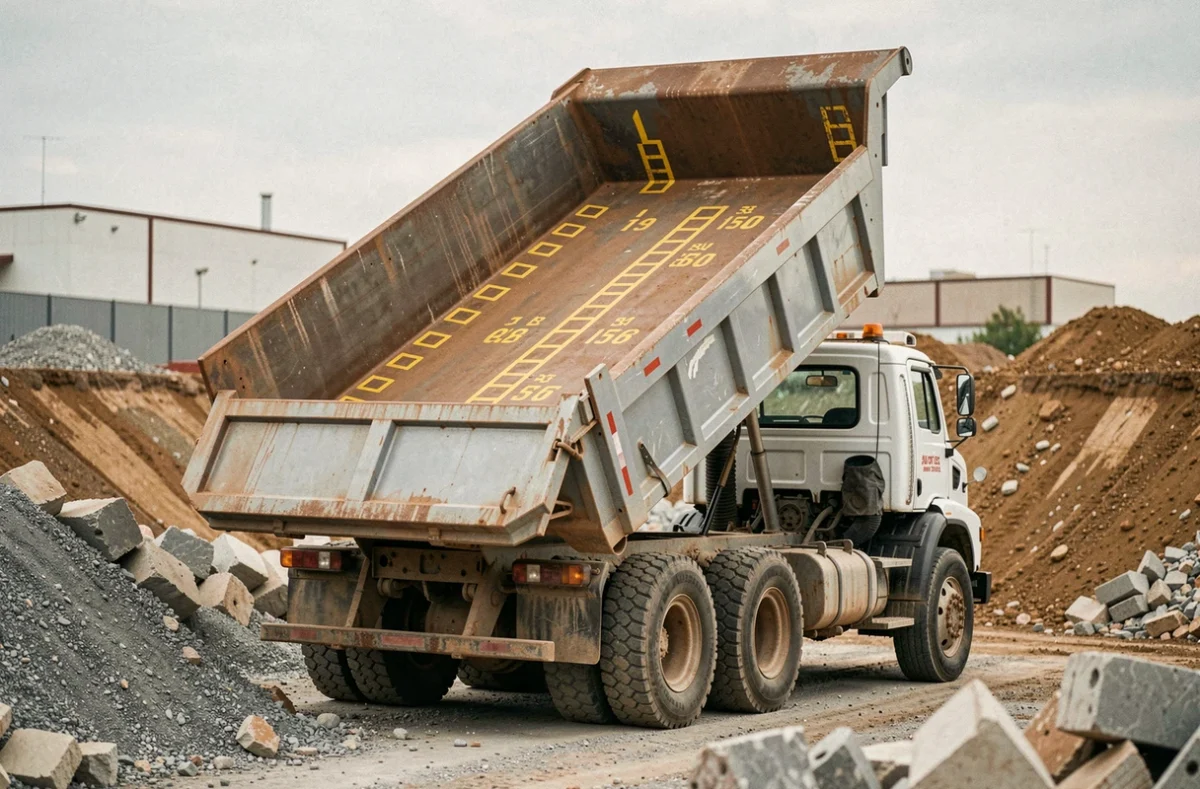
A construction tipper truck has a capacity of 10 m³ listed on its spec sheet. You load it with wet sand, and the driver stops you well before the bed is full: the weight limit has already been reached. This gap between theoretical volume and the amount the truck can actually carry is something most guides fail to explain in detail.
Volume in m³ and payload: two limits to check at the same time
Every tipper truck has two limits. The first is geometric: the bed’s internal volume, calculated from its length, width and side height. The second is regulatory: the payload, calculated by subtracting the vehicle’s unladen weight from its gross vehicle weight rating (GVWR).
A lightweight material such as flattened cardboard fills the bed by volume long before approaching the weight limit. Sand or rubble, on the other hand, can reach the GVWR while the bed still looks half empty. To understand the volume of a tipper truck in m³ accurately, you always need to consider both figures.
The actual payload can also vary from one vehicle to another, even for the same model. Added equipment (such as a loader crane or hydraulic tarp) and debris accumulated at the bottom of the bed increase the unladen weight. Regularly weighing the empty truck is still the most reliable way to determine its exact payload.

Tipper truck capacities: from small rigid trucks to semi-trailers
Tipper beds don’t come in just one size. Usable volume depends on the size of the truck and the number of axles.
- Small rigid trucks, often used in urban areas for waste collection or small deliveries, have beds with a capacity of a few cubic metres, suited to narrow streets and modest loads.
- Medium-sized rigid trucks, commonly used on construction sites, typically have beds with a capacity of between 10 and 15 m³. These are the most common vehicles for transporting sand, soil or rubble.
- Large rigid trucks and semi-trailers have much greater capacities, with beds that can exceed 20 m³ or even reach 30 to 40 m³ in multi-bin or moving-floor configurations designed to transport bulky, lightweight materials.
Bear in mind that the larger the bed, the more critical the gap between volume and weight becomes. A 30 m³ bed filled to the brim with wet soil would far exceed the truck’s GVWR.
Density, moisture and bulking: what changes the calculation for the same truck
Here’s a point that many skip-bin rental quotes leave out. For the same bed volume, the actual load weight can vary by as much as a factor of two, depending on the material.
Material density when dry and wet
Sand is a good example. According to figures reported by DREAL Rhône-Alpes, sand goes from 1.45 t/m³ when dry to 1.65 t/m³ when wet. In a 10 m³ bed, that means an extra two tonnes simply because of rain or outdoor storage.
A downpour the day before loading can therefore be enough to push the truck over its legal weight limit, without adding a single extra cubic metre.
Rubble bulking after demolition
Rubble presents the opposite problem. After demolition, materials break apart, leaving gaps between the pieces. The apparent volume of rubble is greater than the volume of the materials before demolition. A 2 m³ cinder-block wall can produce 3 m³ or more of rubble once broken up.
So, when choosing the right bed size, estimate the volume after demolition, not the volume of the original structure.
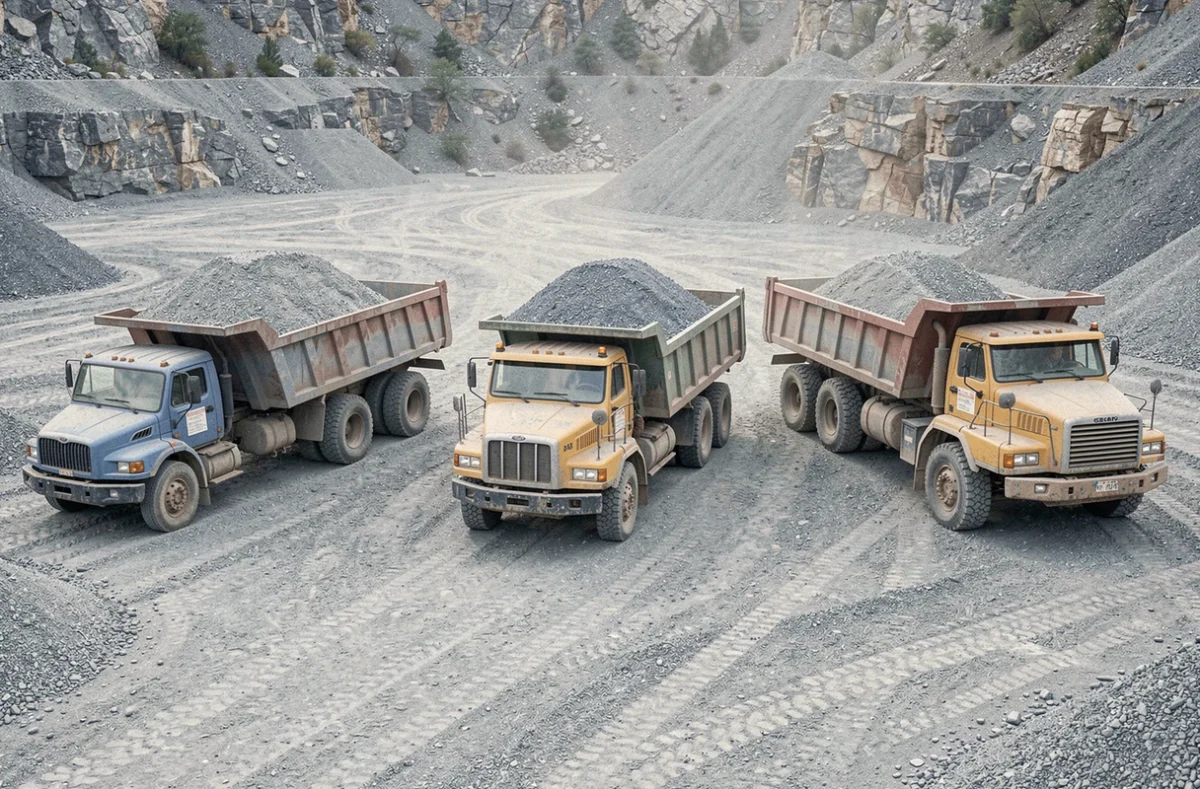
Load distribution across the axles: a constraint that’s often overlooked
Staying within the truck’s overall GVWR isn’t enough. Regulations also set load limits for each axle. A load concentrated at the rear of the bed can overload the rear axle while leaving the front axle below its limit.
In practice, this means a truck can have a compliant total weight on the weighbridge and still be in violation because the load is unevenly distributed. The consequences aren’t just administrative: an overloaded axle reduces braking capacity and impairs handling, especially downhill or on soft ground.
For dense materials such as sand or soil, distributing the load evenly across the bed is a simple precaution that helps avoid this risk. When carrying mixed rubble, placing the heaviest blocks in the centre of the bed, above the load-bearing axle, helps balance the load.
Summary table: volume, material and weight constraints
| Material | Indicative density | 10 m³ bed: estimated weight | Main constraint |
|---|---|---|---|
| Cardboard, lightweight green waste | Very low | A few hundred kg | Volume (bed fills before the weight limit is reached) |
| Dry sand | 1.45 t/m³ | About 14.5 t | Weight (GVWR reached well before the bed is full) |
| Wet sand | 1.65 t/m³ | About 16.5 t | Weight and axles |
| Demolition rubble | Variable, often 1.3 to 1.8 t/m³ | Varies depending on fragmentation | Volume (bulking) and weight |
This table shows that the same 10 m³ tipper truck can carry anywhere from a few hundred kilos to more than 16 tonnes, depending on what’s loaded. Choosing a truck based only on its volume in m³ means looking at just half the equation.
The next time you order a skip for a construction site, ask for the truck’s actual payload and find out the density of your material. A quick calculation (estimated volume multiplied by density) is all it takes to determine whether the bed will be limited by space or by weight. Checking both is the best way to avoid surprises at the weighbridge.