The BSR, now called the AM license, is the subject of many searches associated with the word “free.” The promise of a completely online and cost-free training deserves to be confronted with what the regulations actually allow. Which steps can be done remotely, which must remain in-person, and what arrangements can help reduce the cost of practical training?
Online procedures and in-person training: what the BSR really allows remotely
| Step | Online (free) | In-person (paid) |
|---|---|---|
| ASSR 1 or ASSR 2 (theoretical part) | Preparation possible online, exam taken at school | Taking the test at the educational institution |
| Administrative registration (ANTS / France Titres) | Completely digital, at no cost | Not applicable |
| Practical training (8 hours) | Not allowed remotely | Mandatory at an accredited driving school |
| Issuance of the certificate | Downloadable on ANTS after validation | Initial handover by the instructor |
This table summarizes the central point: the 8-hour practical training must be in-person. No accredited organization can legally validate this part remotely, regardless of the platform used.
The administrative part, on the other hand, is free and entirely digital. The title request goes through the ANTS or France Titres website, without having to go to the prefecture.
For those looking to obtain the free BSR online, the distinction between these two aspects avoids a common disappointment: the “online” covers the administrative and theoretical preparation, not the training on two wheels or in a light quadricycle.

Free BSR: local aids and funding arrangements
There is no universal free access to the AM license. Offers presented as “free BSR” correspond to partial or conditional funding, never to an automatic right.
Several types of arrangements can cover all or part of the cost of practical training:
- Municipal or departmental aids, often reserved for young people under 18 residing in the relevant municipality or department, subject to family income conditions.
- One-off operations led by road safety associations or local missions, which fund training in exchange for a commitment (participation in prevention workshops, for example).
- Arrangements related to professional integration, when mobility on a moped is a condition for accessing a job or qualifying training.
Each arrangement has its own eligibility criteria. Checking with the town hall, the departmental council, or the local mission remains the most reliable approach before enrolling in a driving school.
Actual cost of practical training at an accredited driving school
Prices vary depending on the geographical area and the type of driving school. Price differences between two establishments in the same city can be significant for the same regulatory service.
What explains the price differences
The BSR/AM training includes five mandatory sequences over 8 hours: discussions on road safety, off-road learning, on-road driving, risk awareness, and a module with a parent or legal guardian for minors.
The educational content is regulated. However, driving schools freely set their prices. Two variables affect the price: the cost of the premises (higher in city centers) and the trainer/student ratio during driving sequences.
Comparing quotes from several accredited driving schools near you, ensuring that the price includes all 8 hours and the provision of the certificate, remains the most direct way to reduce the bill without relying on a funding arrangement.
Mandatory equipment: an often-overlooked expense
The candidate must present their own protective equipment for the driving sequences on a moped: approved helmet, certified gloves, and high-top shoes. Some driving schools lend helmets, others do not. This point should be clarified at registration to avoid unexpected extra costs.
ASSR and ASR: the free theoretical part of the BSR
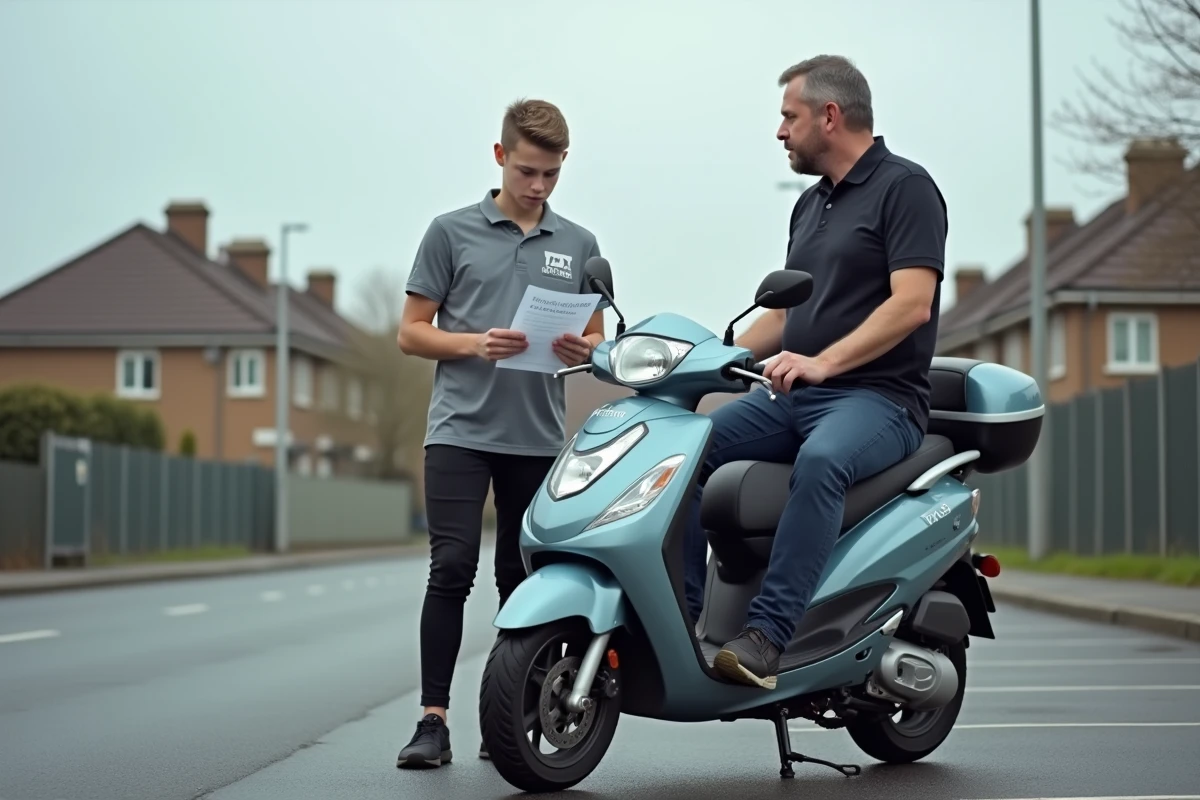
The theoretical training is based on the ASSR (School Road Safety Certificate), taken in 5th grade (ASSR 1) or 3rd grade (ASSR 2). This certificate is a mandatory prerequisite for enrolling in practical training.
For individuals who are not in school or have lost their certificate, the ASR (Road Safety Certificate) replaces the ASSR. It is taken at a GRETA or an accredited training center, free of charge.
Preparation for these tests can be freely done online, via public road safety websites. The quizzes cover signage, traffic rules, and risky behaviors. This preparation is the only step of the BSR that is truly accessible online and at no cost.
Special case: individuals born before 1988
No driving license is required to drive a moped or light quadricycle if the driver was born before 1988. This exemption, often unknown, exempts both the ASSR and the practical training at a driving school.
The digitization of administrative registration and the free theoretical preparation make part of the BSR process accessible from home. The practical training, however, retains an unavoidable cost that only targeted local arrangements can cover. Checking eligibility for these aids before comparing driving school prices is the most effective sequence to limit expenses.