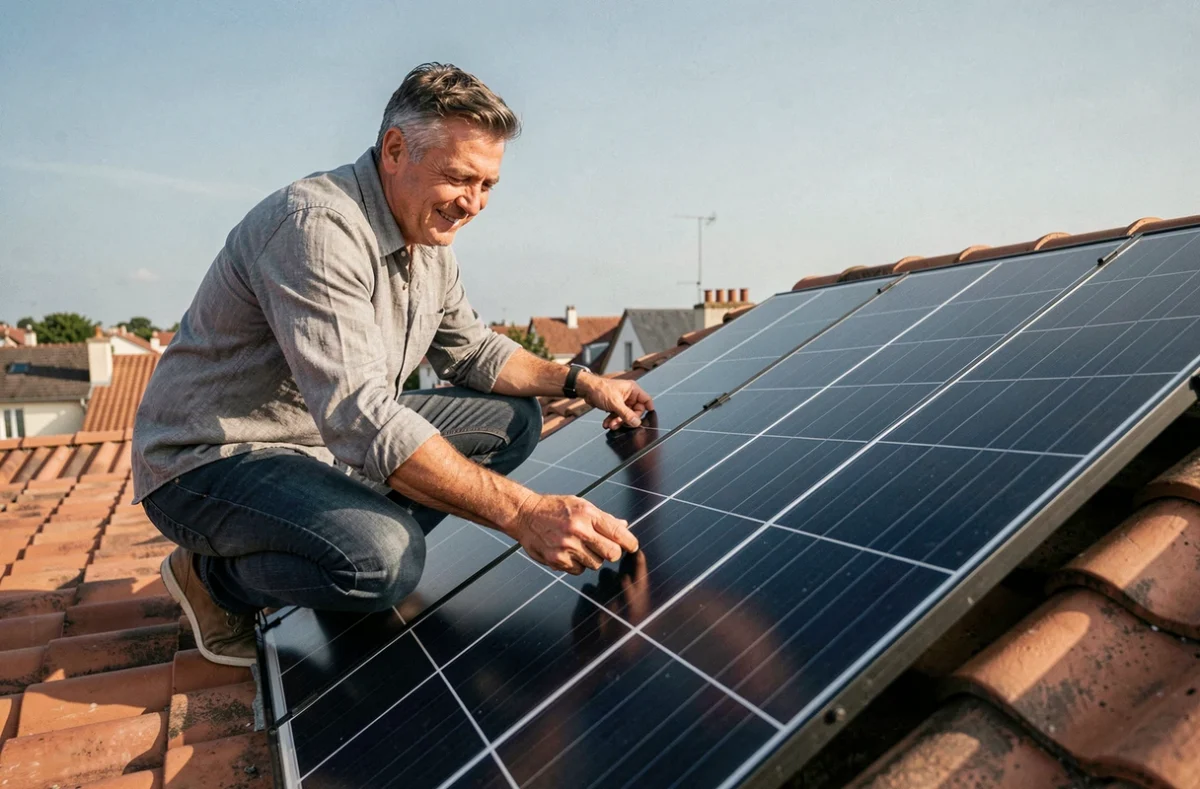
A south-facing pavilion with a thirty-degree sloped roof does not produce the same amount of electricity as a semi-detached house whose roof is partially shaded by a tree. Before discussing savings or ecology, it is this physical reality that determines whether solar energy for your home makes sense. The building configuration, available surface area, and household consumption profile weigh more heavily than any general argument.
Connection and solar power: what changes depending on your installation
It is often thought that installing photovoltaic panels is just about fixing equipment to a roof. However, the less visible part, the connection to the grid, conditions the type of project that can be realized.
Enedis distinguishes between low-voltage installations with a power of less than or equal to 36 kVA and those between 36 and 250 kVA. This distinction leads to different connection procedures and technical conditions. For a typical single-family home, one usually remains below the 36 kVA threshold. As soon as storage batteries are added or several production points are considered, the cumulative power can exceed this threshold and complicate the procedures.
In practical terms, this means that a residential solar project must be sized in advance: peak power in kWc, the number of solar panels, the capacity of the inverter. The resources available on energieosolr.fr help to better frame these technical parameters before contacting an installer.

Photovoltaic self-consumption: producing does not mean disconnecting
Individual self-consumption consists of directly consuming the electricity produced by your solar panels. The unused surplus can be injected into the grid and sold, often at a regulated rate. This mechanism reduces the electricity bill without eliminating the connection to the public grid.
Even in self-consumption, the grid remains necessary to cover needs when solar production is insufficient (night, cloudy days, winter consumption peaks). Enedis confirms that self-consumers maintain a contract with the supplier of their choice for supplementary electricity.
There is often talk of total autonomy. Feedback on this point varies, but in practice, few households achieve complete coverage of their annual consumption solely through solar energy. The realistic goal is to increase the self-consumption rate by adapting habits:
- Run the washing machine, dishwasher, and electric water heater during the day, when photovoltaic production is at its peak
- Schedule the charging of an electric vehicle during sunlight hours rather than at night
- Install an energy manager that automatically redirects surplus to the most energy-consuming devices
Collective self-consumption: a solar model among neighbors
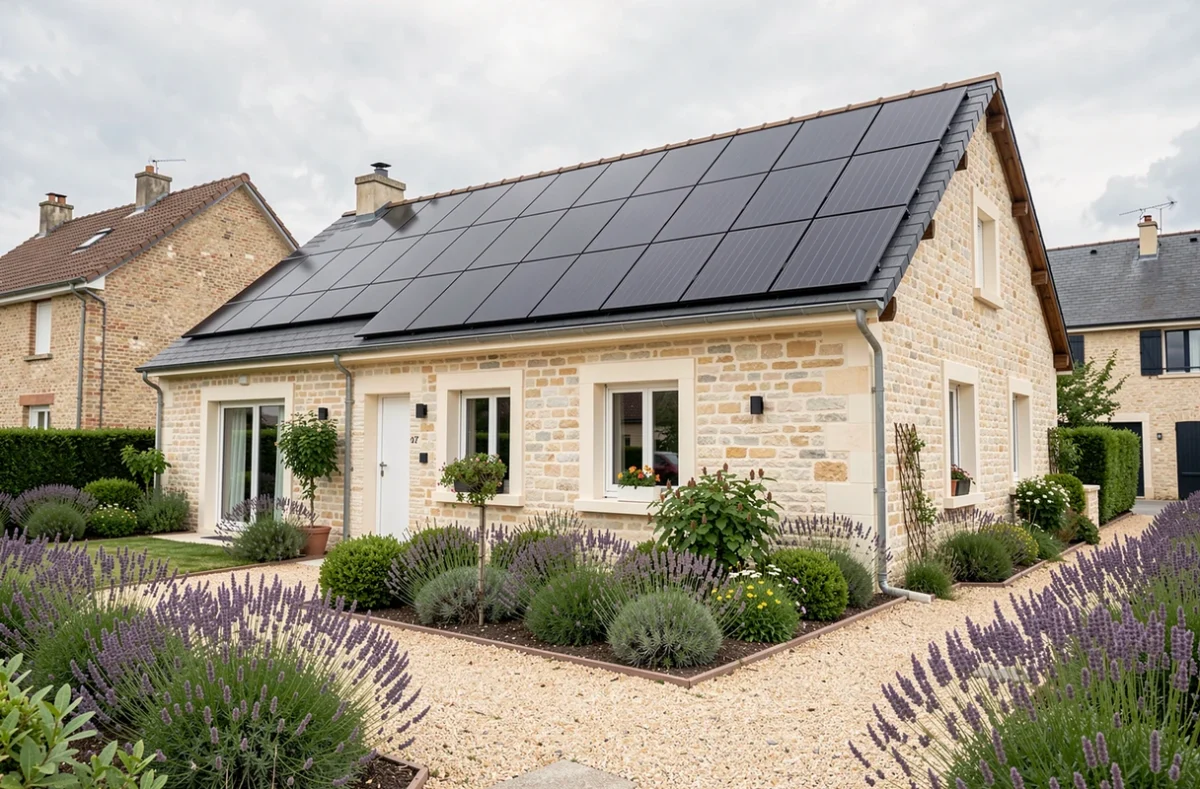
Collective self-consumption remains little known, yet it opens possibilities for condominiums, housing developments, or small business areas. The principle: several nearby homes or buildings share local solar production.
According to Enedis, participants must have smart meters and be connected to the public grid. An organizing legal entity concludes an agreement with Enedis to manage the flows. Each participant retains their own supply contract for supplementary electricity.
This model is particularly suitable for situations where a single roof is not sufficient or when a building has a large area of unused roof space (warehouse, commercial space). The production is distributed among the members according to a distribution key defined in the agreement.
Constraints to anticipate
The administrative setup is more complex than for an individual installation. It is necessary to establish the legal entity, negotiate the distribution among participants, and ensure follow-up with Enedis. For a housing development of a few houses, coordination takes time before seeing the first shared kilowatt-hours.
Size your solar panels according to your actual consumption
The classic trap is to oversize the installation, thinking that more panels mean more savings. In self-consumption, oversizing generates surplus that is difficult to monetize if the buyback rate is low compared to the investment cost.
The correct method starts from the household’s annual electricity consumption, expressed in kWh. This data is crossed with local sunlight, roof orientation, and slope to estimate the necessary peak power in kWc. A moderately consuming household does not need the same surface area of photovoltaic panels as an all-electric house with a heated pool.
Some concrete benchmarks to avoid mistakes:
- Check your monthly consumption over the past twelve months via the smart meter or the supplier’s customer area
- Identify the most energy-consuming devices (electric heating, water heater, air conditioning) and their time slots
- Request several quotes with different power levels to compare the estimated coverage rate and return on investment
- Ensure that the installer offers production monitoring after commissioning
Shade, this underestimated factor
A partially shaded panel sees its production drop disproportionately. A chimney, tree, or neighboring building that casts shade on part of the roof can reduce the yield of the entire system if the panels are wired in series. Having a shading study conducted before any installation avoids unpleasant surprises once the system is in place.
Residential solar energy is neither a miracle solution nor a gadget. It is a technical installation that requires appropriate sizing, well-prepared connection, and adjusted consumption habits. Households that get the most out of their solar panels are those who have taken the time to measure their actual needs before signing a quote.