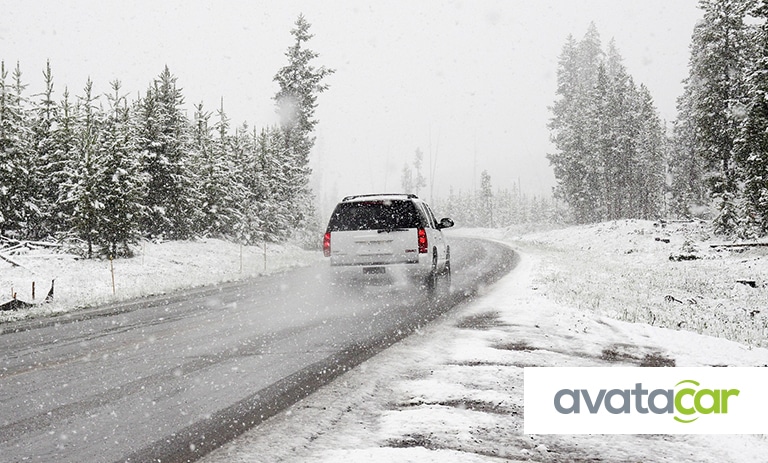
It’s winter! Snow has already settled in some regions, and it’s time to go on a ski vacation. After the stress of preparations, there’s another concern: how to better prepare for driving in the snow? What behaviors should you adopt behind the wheel? And what if your car skids in the middle of a turn? Avatacar gives you 10 tips to keep in mind when you hit the snowy roads.

1. Equip yourself with winter tires
When the temperature drops below 7°C, it’s essential to replace your summer tires with winter tires. Indeed, at this temperature, the rubber of a summer tire hardens and loses all its effectiveness. Conversely, the winter tire has much softer rubber. Thus, it is resistant to low temperatures and retains all its properties on snow or ice. Additionally, winter tires have a large number of treads, which enhance grip in winter conditions.
Winter tires are therefore much better on snow than summer tires. They ensure much better safety by allowing the driver to maintain control of their vehicle.
Note: Studded tires are known to be very effective on ice, but they are not really suitable if you are driving on snow. Choose winter tires marked 3PMSF and M S.
Find all the benefits of winter tires in our article Why choose winter tires?
2. Put winter tires on all four wheels
In the case of a two-wheel drive car (front or rear-wheel drive), it may be tempting to only install two snow tires to save money. But that’s a mistake! Indeed, regardless of your vehicle’s transmission, it’s essential to put snow tires on all four wheels. Otherwise, the stability and direction of your vehicle will be affected. If you only equip the front tires of a front-wheel-drive vehicle, it may veer off its trajectory during braking or in turns. If you only have two wheels equipped on a rear-wheel-drive vehicle, it may struggle to turn.
3. Check your vehicle before departure
Before driving on snow, it’s worth preparing your car well in advance, even if you’re only making short trips. Winter is not the most popular season for our cars, far from it! To avoid breakdowns, several checks are essential before departure.
First, check the condition of your windshield wipers and replace them if necessary. Visibility is very important while driving. This is especially true in the snow, where every turn of the steering wheel or sudden braking could cause you to skid. Consider using a special winter windshield washer fluid that will resist freezing, and check the various fluid levels.
Next, check the pressure and wear of your tires. In winter, tires tend to lose pressure. So make sure your tires are sufficiently inflated. Otherwise, they will wear out much faster, and your fuel consumption will be higher. Also, check the tread depth of your tires. For a winter tire, it should not go below 4mm. If it does, change your tires immediately.
If you’re going to the mountains or if the weather forecasts heavy snowfall, don’t hesitate to have your vehicle checked in the garage. A professional can also check your brakes and shock absorbers, two elements that must be in good condition to ensure the best possible safety on snow.
Find all our tips for maintaining your car during winter.
4. Adapt your driving
Before you leave, we also advise you to plan your trip according to the weather. You know you’ll be driving more slowly on snow, so allow yourself extra time to avoid the risk of arriving late at your destination.
If you’re used to avoiding major roads (highways, departmental and main roads), for example, to escape traffic jams, change your route! When it snows, smaller roads tend to be riskier. In fact, they are less clear, and snow removal machines rarely pass through them, if at all. Prefer major routes, which are less dangerous.
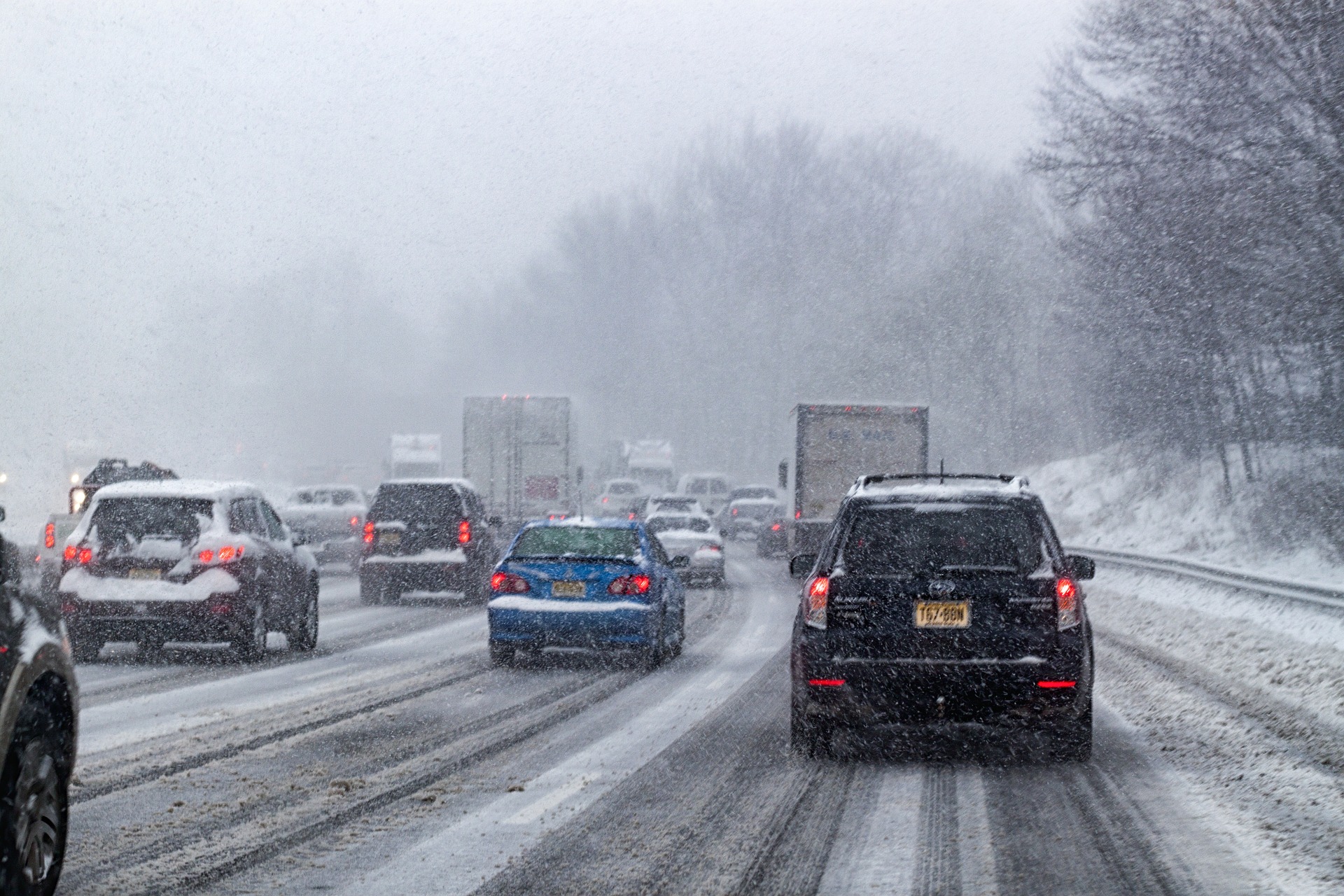 When driving on snow, it’s necessary to be extra vigilant and cautious. Drive slowly and maintain at least a doubled safety distance between you and the car in front of you. Drive at low revs and shift speeds as soon as possible, which will reduce the risk of losing grip, often associated with too much engine torque. Adopt a smooth driving style without any sudden movements. Acceleration, braking, turning, everything should be done smoothly. Also, think about looking far ahead: anticipation is even more important on snow. Indeed, if you brake or turn at the last moment, your wheels may skid.
The Highway Code recommends certain behaviors when driving on snow. For example, you must always give priority to snow removal vehicles, regardless of the situation. Moreover, it is forbidden to overtake them, even if you are forced to drive at 30 km/h or slower. You must always turn on your low beams when driving on snow. In case of heavy snowfall, turn on your fog lights.
5. Equip yourself with snow chains
If you are driving on a heavily snow-covered road, equip your wheels with chains or socks. The right time to put them on is when you start to feel a loss of grip. But be careful not to wait too long to place them, or you might find yourself stuck in deep snow! Often, road signs indicate that the use of snow chains becomes mandatory. However, you should know that it is prohibited to stop on the side of the road to put on your chains. Stop in the first chain area you find on your way to do it safely.
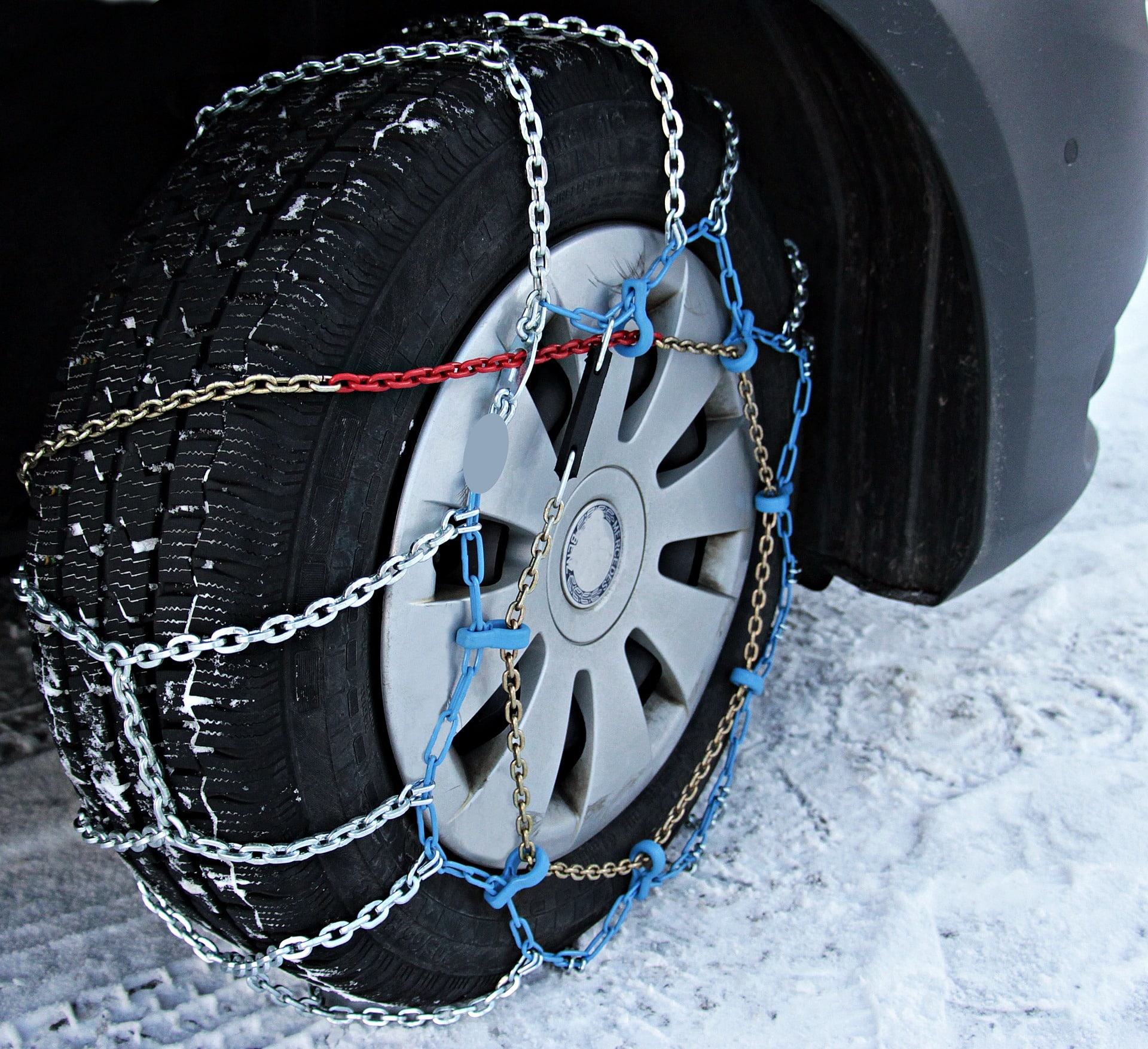 Snow chains are mounted on the driving wheels. If you have a front-wheel-drive vehicle, put your snow chains on the front two wheels. If your vehicle is rear-wheel drive, mount them on the rear two wheels.
Contrary to popular belief, driving a 4×4 in the snow does not exempt you from using chains. Ideally, all four wheels should be chained, as they all provide traction. Indeed, if you only chain the front two wheels, your vehicle may skid during acceleration and will be difficult or impossible to control. On the other hand, if you only chain the rear two wheels, you risk losing grip during braking and downhill, as well as losing control of your wheels in turns. In both cases, this can be extremely dangerous.
If your budget does not allow you to acquire two pairs of snow chains, prefer the front axle, but drive very slowly and with maximum caution.
6. Take advantage of driving aids
Today, most vehicles are equipped with built-in driving aids. These can be very useful if you lack confidence on snow. For example, ESP allows you to correct the vehicle’s trajectory in turns and prevents you from skidding.
However, ESP can be a problem when starting, especially if you’re on a slope and the ground is icy. Indeed, it includes an anti-slip function that can lock the wheels and prevent starting. To avoid this, it’s advisable to disable the ESP at startup and activate it again once the car is moving. If your car is new, your ESP system may have a position that allows for some wheel slip (to a lesser extent). If that’s the case, you can choose this option for driving on snow.
Some vehicles are equipped with an anti-slip function. This is very useful when starting in the snow.
7. What to do in case of skidding?
If you lose control of your wheels and your vehicle skids on the snow, the first thing you need to do is stay calm and direct your gaze in the direction you want to go. Try to prevent the car from moving forward gradually. The first reflex you might have is to brake, but that would only worsen the situation. Therefore, it is absolutely not recommended to touch the brake pedal. To stop your vehicle’s progression, disengage. This will stop the power transmission from the engine to the wheels and thus slow down the vehicle. You will then have more time to regain control of your vehicle properly.
There are two types of skidding: front (understeer) and rear (oversteer). If the front wheels are skidding, gradually lift your foot off the accelerator pedal. Do not release it suddenly! You need to act gently to avoid a dangerous reaction from your vehicle. This will restore grip to the front tires. Keep your gaze in the direction you want to go. As soon as you feel that your wheels have regained traction on the ground, you can straighten your steering wheel in that direction and accelerate again.
If the rear wheels are skidding, you need to prevent your vehicle from spinning out. To do this, it is necessary to counter-steer. This means that if your wheels are going to the right, you will need to steer correctly while easing off the accelerator. If despite this the car spins out, keep your foot firmly on the clutch and let your car spin until it stops. You can then regain your direction.
In conclusion, whatever the situation: 1. Stay calm; 2. Look in the direction you want to go; 3. Do not brake and accelerate; 4. Disengage to stop the vehicle; 5. If the wheels go forward, gently release the accelerator. If they go backward, counter-steer.
8. What to do if your wheels spin at startup?
If you feel your wheels spinning in the snow at startup, you need to reduce the power of the acceleration. To do this, release the clutch very gradually and make sure your wheels are straight. If that’s not enough, try to start in second gear, which will reduce the risk of spinning. You can also place a floor mat in front of each driving wheel to gain some grip. Or, if you have several people, some can get out to push the car!
9. What if your vehicle is stuck in the snow?
If your vehicle is stuck in the snow, the first thing to do is to clear the snow as much as possible. If your exhaust is covered with snow, clear it. Also, remove as much snow as possible around your wheels. Depending on the direction you want to leave, clear the snow between your wheels and the part of the road you want to reach.
Then, get back in your vehicle and try to start without pressing the accelerator too much. Follow the advice we just provided to avoid spinning at startup.
10. How to drive in the snow with an automatic transmission?
Some automatic transmissions are equipped with a snow mode. If this is the case with your vehicle, remember to engage it when driving on snow. This snow mode helps to avoid spinning at startup, as it starts your car directly in second gear.
If your automatic transmission does not have this option, it is very likely that it has a D2 position. It works on the same principle: it starts the car in second gear and prevents the wheels from spinning.
If you do not have the snow mode or D2 position, it is advisable to set your automatic transmission to position 2 when you start to avoid spinning.
On some automatic transmissions, there is also the “overdrive” option, which allows for a higher transmission speed in the direction of the wheels. If you have this option, it is recommended to disable it when driving in the snow. The overdrive mode can cause you to lose control of your wheels on snowy or wet roads. For your safety, remember to disable it!
In case of skidding, the procedure to follow is the same as for a manual transmission. With a manual transmission, it is necessary to disengage to stop the power transmission to the wheels. With an automatic transmission, the gear should be shifted to neutral, which is in the “neutral position”. As soon as you feel that you have regained traction, you will be able to return to the “drive” position to regain your trajectory.
The key to safe driving on snow is to be well-equipped, drive slowly and carefully, and stay calm in case of skidding. Knowing this, you will be able to drive with peace of mind!

Sources: Continental, Argus, Le Figaro, BFMTV, Uniroyal
Tag: install snow chains